






Nautical Magnetic Compass Navigation Heading Repeater Compass CF 3
CF-3 Heading Repeater Compass,Marine Heading Repeater Compass,magnetic compass repeater CF 3: 1.it has small volume 2.can be used for flush mounting, wall mounting or desk mounting

- Product Introduction
Ruian Shunfeng Navigation Instruments Co.,Ltd: Your Leading Magnetic Compass Supplier
Ruian Shunfeng Navigation Instruments Co.,Ltd.is an enterprise in professional manufacturing "Shun Feng" brand marine navigation equipments and fittings . The company was established in 1980 and is located in C District, An Yang Industry, Rui An City, Zhe Jiang Province. The company covers an area of 5.98 mou and a building area of 4,000 square metres. The company is close to Yon Tai Wen expressway and 104 national highways, traffic is very convenient.
Why Choose Us?
Quality products
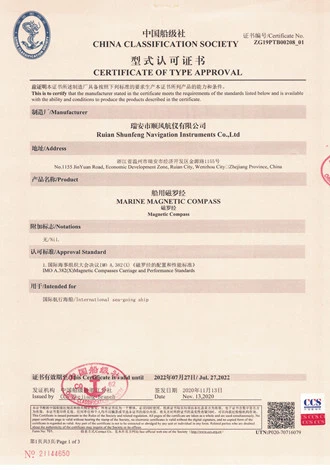
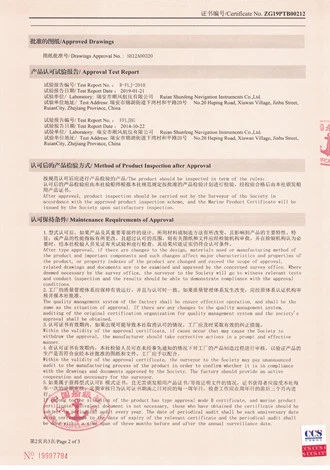
We have the most advanced production equipment, and our products are approved by China Classification Society and China fishing boat inspection bureau and obtain CCS and ZY type approval certificates.
Rich experience
Since its establishment in 1980, we have been widely recognized and highly praised by enterprises and consumers for our excellent quality and thoughtful service.
Reliable service
Our team is committed to providing reliable and consistent service, ensuring that you receive high-quality products and customer support from us every time.
Professional team
The company is in possession of numbers of senior engineers and has abundant technique power, well conditioned equipment and technology comes to perfection.

The Basic Concepts of Nautical Magnetic Compass
Using a magnetic compass connects you with the world on foot, by ship, in the air, and by many other means that dates back centuries and covers the globe. The basic principle behind this enduring technology has stood the test of time, and is still required in many cases even when sophisticated satellite-based navigation is available.
The operation of a nautical magnetic compass is a basic principle that's been in use to facilitate travel and trade for about a thousand years.


When combined with today's comprehensive navigational charts, it can be used for oceangoing travel as well as making port anywhere in the world. The key to the modern compass is understanding its accuracy limitations and why they exist. With that knowledge, precision compasses using several basic principles including magnetic fields can be built, used, and maintained for safe voyages.
A magnetic compass originally indicated direction because of the alignment of the magnetized metallic "needle," typically a piece of iron or steel.
● A magnetic compass indicates direction because it is free to rotate and align with earth's magnetic field.
● Card compasses use magnets attached to a card marked with directions that rotates on a pivot.
● Modern magnetic sensors used in electronics can be used to create magnetic compass devices.
● Advantages and disadvantages of magnetic compass technology have made it a universal navigation instrument but more complex to use in modern times, in particular on metal ships.

How Are Nautical Magnetic Compass Calibrated Accurately?
Every ship at sea is required to have a nautical magnetic compass, and that instrument must be "swung" or calibrated, usually by an expert who gets paid a fee for that service. I used to swing my own compass, as part of the seamanship required of a ship's master. The output of this process is a graph or a table showing the correction to be applied, the deviation, in degrees plus or minus to the actual compass reading. It should be less than 5 degrees.
The reason for deviation is the magnetic material which is always present aboard, even if the ship's hull is not steel. This magnetic field is part of the ship and moves with the ship. In extreme cases the adjuster can neutralize some of the ambient magnetic field with pieces of iron or small magnets, but it's better to find a location for the compass that has less of an ambient field and yet is readable from the helm station.
The compass had weak magnets built in that were adjustable with a small screwdriver. We motored in circles and adjusted the magnets to reduce the deviation in increments, first on north-south courses and then on east-west courses, until we got as close to zero as possible. It was tricky.

The reason for deviation is the magnetic material which is always present aboard, even if the ship's hull is not steel. This magnetic field is part of the ship and moves with the ship. In extreme cases the adjuster can neutralize some of the ambient magnetic field with pieces of iron or small magnets, but it's better to find a location for the compass that has less of an ambient field and yet is readable from the helm station.
The compass had weak magnets built in that were adjustable with a small screwdriver. We motored in circles and adjusted the magnets to reduce the deviation in increments, first on north-south courses and then on east-west courses, until we got as close to zero as possible. It was tricky.
Modern GPS navigation systems can compensate for variation, but deviation must be entered manually when they are first set up.
Electronic compasses can correct for deviation just by driving around in circles, observing the deviations, and storing the corrections. However, if the electronics quit, you are back to a magnet stuck to a dial and you will need a deviation table.
How Does an Nautical Magnetic Compass Work?
Near the "true north" point of the earth is a location near but not exactly on the rotational north axis. (true north), remembering that in a magnet, like poles repulse, and unlike poles attract, we have a situation that allows us to make a compass.
A metallic pin that is magnetized, when set in a low friction bearing will be attracted to the magnetic pole. Remembering that this attraction is very weak, the bearing must be almost frictionless.
So, the north magnetic pole and the south pole of the pin pull on each other magnetically. The pin turns on the bearing until it points at the oppositely charged pole, and that gives us the direction of the north magnetic pole. The end of the pin is marked as north since it points in that direction.
Remembering that the north magnetic pole is not actually located at the earth's axial (true) north pole, the compass will be off by some amount. That amount changes slightly, over time, depending on the conditions at the core of the earth over the decades. The accuracy also is affected by your location on the earth while reading the compass.
How Was the Magnetic Compass Invented?
The magnetic compass is a navigation tool that uses the Earth's magnetic field to determine the direction of north. It is not clear exactly when or where the magnetic compass was first invented, but it is believed to have originated in China during the Han Dynasty (206 BCE – 220 CE).
According to legend, the magnetic compass was first used by the Chinese philosopher and politician Zhuge Liang (181-234 CE), who is said to have used it to predict the movements of the sun, moon, and stars. However, the first written record of the magnetic compass being used for navigation is from the Song Dynasty (960-1279 CE).
In the early days of its use, the magnetic compass was primarily used for navigation on land, particularly for military purposes. It was also used for divination, as some people believed that the compass could be used to predict the future.
Over time, the magnetic compass was adapted for use on ships at sea, where it became an essential tool for navigation. It allowed sailors to determine their direction and keep track of their position, even when they were out of sight of land. The magnetic compass has continued to be an important tool for navigation to this day, and it is used in a variety of applications, including aviation, surveying, and outdoor recreation.
The Principle of the Nautical Magnetic Compass

An nautical magnetic compass is a very critical piece of marine navigational equipment. It has a magnetized needle which suspends freely. It points north because of the forces caused by the earth's magnetic field. After knowing north, the other directions are easily found.
An nautical magnetic compass works because the earth is like a very big magnet and surrounded by a huge magnetic field. The earth has two magnetic poles near the north and south poles. This magnetic field of the earth causes a magnetized 'needle' of iron or steel to swing freely into a north-south position.
An nautical magnetic compass is a very critical piece of marine navigational equipment. It has a magnetized needle which suspends freely. It points north because of the forces caused by the earth's magnetic field. After knowing north, the other directions are easily found.
An nautical magnetic compass works because the earth is like a very big magnet and surrounded by a huge magnetic field. The earth has two magnetic poles near the north and south poles. This magnetic field of the earth causes a magnetized 'needle' of iron or steel to swing freely into a north-south position.
The Importance of Nautical Magnetic Compass in Navigation Ships
The nautical magnetic compass is designed to withstand the harsh conditions of the marine environment. Its durable construction ensures that it can endure rough seas, strong winds, and exposure to saltwater without compromising its accuracy. This reliability is essential for sailors who depend on their instruments to guide them through unpredictable weather and challenging sailing conditions.
One of the key features of the nautical magnetic compass is its ease of use. The clear markings and intuitive design make it simple for sailors to take accurate readings and make informed navigational decisions. Whether used as a primary means of navigation or as a backup to electronic systems, the compass provides a sense of security and confidence to those at sea.
In addition to its practical functionality, the nautical magnetic compass also embodies a sense of tradition and heritage in maritime navigation. While modern technology has introduced advanced navigation systems, the compass remains a symbol of seafaring history and serves as a reminder of the skills and knowledge passed down through generations of sailors.
The nautical magnetic compass plays a vital role in ensuring safe and successful voyages for sailors around the world. Its combination of reliability, usability, and historical significance makes it an indispensable tool for anyone navigating the open waters.
The Nautical Magnetic Compass: Changing History
In the early days of land and sea exploration, adventurers recorded their travels and experiences and established descriptions and then charts that provided a track for others to follow. Trade routes were developed using those directions. As basic nautical magnetic compasses came into use, they first appeared in china two thousand years ago but as a more decorative than practical device. On a more widespread and practical basis they became popular around the 11th century, and travel became more reliable and efficient.
The simple nautical magnetic compass played a large role in the expansion of people's knowledge of the world, and in the commerce that followed. Sailing trade routes brought exotic goods and spices, and the silk road trade route was enhanced by use of the compass. The silk road also impacted bringing the device to many new cultures, and in a sweeping leap to today, it's still making a large difference in travel and trade of all kinds.
Understanding Your Nautical Magnetic Compass
1. Mounting
If you are installing an nautical magnetic compass, the first thing you need to determine is where and how to mount it. Flush-mounted compasses, mounted horizontally on the helm, take up less space and are generally the most stable. If that is not an option on your boat, there are also surfaces, binnacle- and bracket-mounted compasses that don't require space underneath to install. No matter how you install one, it's crucial that the compass's lubber line be parallel with the keel along the centerline to get a proper reading.
2. Magnetic north
An nautical magnetic compass will have one set of magnets that is balanced to seek out magnetic north. Magnetic north is not true north - as in the north pole - but the location of earth's north polarisation, near greenland. The compass rose on nautical charts shows the difference, called variation, between true north and magnetic north for navigation
3. Corrector magnets
A quality marine compass will also house a second set of magnets called the corrector magnets. These correct the deviation that can occur from interference caused by your boat's electronics or other magnetic sources. The correctors are connected to adjustable brass rods installed in the lower portion of the compass housing, enabling your compass adjuster to compensate, or "swing," your compass card to adjust for deviation.
4. Gimbals
To protect the compass from jostling around with a boat's normal pitch and roll, it's imperative that a marine compass has a built-in gimbal system. The system is mounted on spring-loaded brass pins and kept level with a weighted brass counterbalance.
5. Cards
The dial, also called the card, is the numbered circular piece you use to read the degree of heading. It rotates on a steel pivot mounted on a sapphire jewel "movement" that helps with smooth turning. Front-reading compasses have a semisphere card, good for eye-level readings, but the flat card style is dampened, thus more stable in rough water. This style also allows you to take bearings relative to your course.
Why You Need an Nautical Magnetic Compass?
During the last century, other instruments have become more user-friendly, such as the gyro compass which points to true north, and recently the satellite compass, which relies on satellites for information and also points to true north. The magnetic fluxgate compass, which uses the earth's magnetic field for direction, is also used with automatic pilots and works in a very limited magnetic field.
The gyro, the satellite and fluxgate compasses are reliant on electrical power to make them work. This, among other reasons, is where the magnetic compass has the advantage; it does not rely on an external power sauce.
How do you fix this problem? One has only to apply a small calculation for it to read true north. To make the magnetic compass accurate and perform properly, it has to first be placed in the fore and aft line of the boat. If it can be mounted on the centreline of the boat, it can be aligned with the bow of the vessel. This is the preferred position. If this is not possible, then the compass should be placed either side of the centreline but must be parallel to the centreline of the vessel. This alignment is most important as the compass will have a permanent error in it if it is not aligned properly in the fore and aft line of the boat.

Final adjustment to the magnetic compass can be achieved by built-in corrector magnets (compensators) being adjusted. This can be done by the owner, or preferably, by a licensed compass adjuster who will check, adjust and supply a certificate of deviations for the vessel. The only errors to be applied to the magnetic compass are (a) variation and (b) deviation. These are combined to give the total correction to obtain the true course.
Final adjustment to the magnetic compass can be achieved by built-in corrector magnets (compensators) being adjusted. This can be done by the owner, or preferably, by a licensed compass adjuster who will check, adjust and supply a certificate of deviations for the vessel. The only errors to be applied to the magnetic compass are (a) variation and (b) deviation. These are combined to give the total correction to obtain the true course.
Our Certificate
All our products are approved by China Classification Society and China fishing boat inspection bureau and obtain CCS and ZY type approval certificates. Our company has been found to conform to Quality Management System standard ISO 9001:2000 approved by China Classification Society Quality Assurance (CSQA).



FAQ
Q: What is the purpose of the magnetic compass on a ship?
Q: What is a nautical magnetic compass in simple terms?
Q: What is the uses of nautical magnetic compass?
Q: What is nautical magnetic compass on ship?
Q: Why was the nautical magnetic compass important?
Q: What is a nautical magnetic compass and how does it work?
Q: What is a compass used for short answer?
Q: What are the two errors of nautical magnetic compass?
Q: What is the principle of nautical magnetic compass work?
Q: What is the principle of nautical magnetic compass and gyro compass?
Q: Why is a nautical magnetic compass used to determine direction?
Q: What are the 5 points on a nautical magnetic compass?
Q: What is the theory of nautical magnetic compass adjustment?
Q: Why does a nautical magnetic compass always point towards north?
Q: Why do nautical magnetic compasses become useless in the geographic poles?
Q: What is a heeling error in a nautical magnetic compass?
Q: Why does a nautical magnetic compass have errors?
Q: Who invented the nautical magnetic compass?
Q: What is a nautical magnetic compass and how does it work?
Q: What are the advantages of gyro compasses vs nautical magnetic compasses?
Hot Tags: nautical magnetic compass navigation heading repeater compass cf 3, China, manufacturers, supplier, wholesale, price


