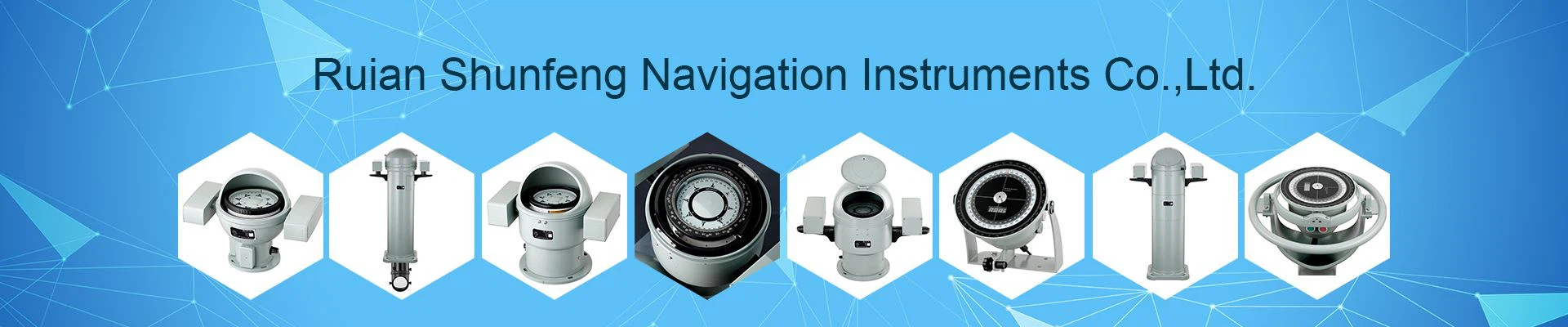
An azimuth is the direction measured in degrees clockwise from north on an azimuth circle. An azimuth circle consists of 360 degrees. Ninety degrees corresponds to east, 180 degrees is south, 270 degrees is west, and 360 degrees and 0 degrees mark north.

Azimuth is a very natural concept. It corresponds to the natural notion of "angle of a direction with the north". However, defining it in 3d requires a few more words.
Azimuth is the angle made with the magnetic northpole line on the surface of the earth. In other words it is the angle marked on your compass with an object located at the horizon.
In other words still, if you stand in the middle of a plain or of the sea, where you can look at any point on the horizon, and if your compass is drected with its 0 on the magnetic arrow, the azimuth of any horizon point is the angle that you can read on the scale of the compass.
Hope this is clear. It is most straightforward to show, but a little more delicate to explain with words.
The figure below shows a star as it be defined by its azimuth and elevation (also sometimes called altitude).
Azimuth in any reference frame is a full-circle measurement of orientation, clockwise when looking down, and with the zero point usually assigned to some kind of north. Whether you are working on a sphere or a plane, that's how it works. In most cases, we user degrees, minutes and seconds for the angle, as that is traditional.
Which north is selected for the zero is up to the person doing with work, but it should be specified. It may be true north, magnetic north, magnetic north at some specific date, grid north (of which there are almost an infinitude of options) or even something else.
In the US, you can also have an 'arbitrary azimuth' where the zero is completely arbitrary, which is something of a contradiction. In part of the world where quarter-circle bearings have fallen into disuse, the term 'bearings' may be used for this 360° reference with an arbitrary zero, at least among surveyors. Among navigators, ‘bearing' has a somewhat different meaning.
So if you are using azimuths with degrees, north is 0°, east is 90°, south is 180° and west is 270°. You can get azimuths from a map or chart using a 360° protractor with the zero aligned with the direction of north on the map or chart. On nautical charts, there is usually at least one compass rose, and you can transfer any orientation on the chart to the compass rose for azimuth measurement using parallel rulers. This avoids having to sort out protractors.
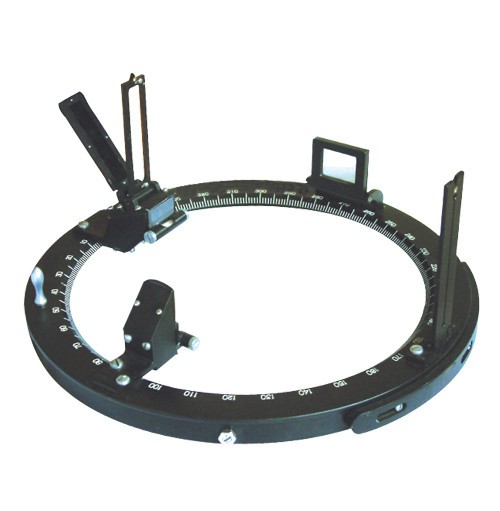
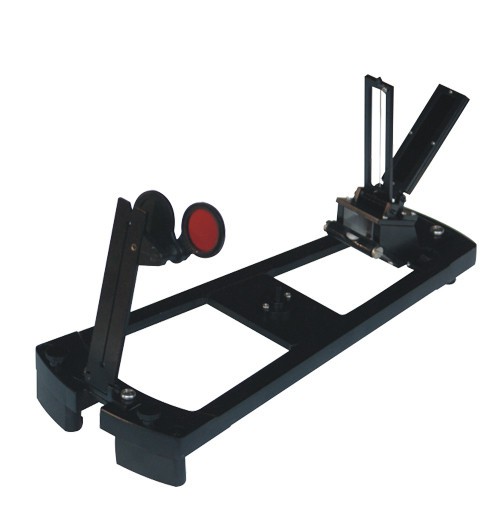
The azimuth circle which has been a service stand-by for many years, plays an important part in navigation and is so well known that no description is considered necessary. Although sufficiently rugged to withstand ordinary use, accidental knocks or misuse will cause derangement. When out of adjustment the fault is difficult to determine and rectify with the facilities found on board ship. An error in the circle fittings affecting azimuths, affects the course laid by the amount of the error. As an example of this relation the experience of a certain ship is given. This ship while on a long voyage had a consistent, unaccountable set of about ten miles a day. As day after day elapsed with a set of approximately the same amount, it was suspected that the azimuth circle was out of adjustment. Comparison with other circles developed the fact that none of them agreed. Later when there was an opportunity to have the circle checked it was found to be out a degree and a half, which error almost exactly accounted for the set experienced.
Many navigators send azimuth circles to the Naval Observatory or to a navy yard instrument shop for checking when an opportunity is afforded. Some repair ships are now equipped to adjust circles. Were it possible to make a positive check on board ship, much of this work could be avoided.
The commonly accepted test is to check an azimuth by the sun mirror against a direct azimuth with the terrestrial vanes. This also is the instrument shop test, but when conducted on board ship it is not conclusive as it requires the presumption that the terrestrial vanes are in adjustment. It is true that the vanes themselves are not so subject to derangement as the sun-mirror prism arrangement, but the test usually requires the dark mirror to be used and the latter is more subject to derangement than any other part of the circle. At an instrument shop the adjustment of the terrestrial vanes and the dark mirror can be checked and the subsequent sun-mirror check is then conclusive.
On first reading, the description will appear to be very technical, but any reader who is sufficiently interested to break out an azimuth circle for reference while reading will find that the procedure is easily understood.
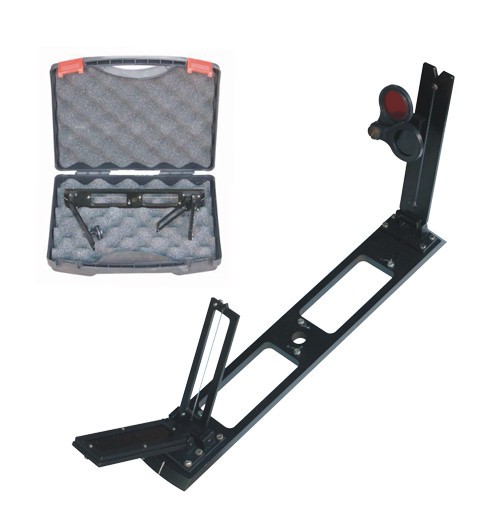
In the most basic forms, a azimuth circle is made up of a floating dial marked with an arrow that is drawn to earth's magnetic north. With that single piece of information, you can get a rough approximation of your bearing. Any compass worth carrying will include degree markings for more precision. More markings mean more accuracy, and we recommend finding a military-style compass that shows 360 degrees.
Don't bother getting carried away with minutes and seconds (60 minutes per degree, 60 seconds per minute). A fixed index line will show the compass body's orientation in comparison to the floating dial.
Because compasses are magnetic tools, it's critical that you remember to check your surroundings for things that can interfere with their operation. Metal objects as small as a rifle can throw off your compass readings. Vehicles and power lines can be especially disruptive. Distance yourself from large metal objects to get a more accurate reading.
Once you shoot your azimuth, walking directly on it is an effective–but tedious (and sometimes impossible)–technique. If you choose this method, selecting nearby reference points or limiting travel to about ten paces in between re-sighting can improve accuracy. Be aware of how terrain features like slopes and ground surfaces affect your gate.
We recommend using a combination of compass readings and terrain features to navigate. Start by identifying a fixed object along your azimuth and walking to it using the most efficient route. If you can see a reliable midpoint, you can avoid making deep river crossings and struggling through thick underbrush just to keep moving in a straight line.
Night navigation can make it impossible or impractical to use the sights on your compass with the compass-to-cheek method. When that's the case, you'll need to hold the compass against your torso at the bottom of your rib cage and perpendicular to your body. Luminous markings will let you get your bearing and point you in the right direction. Remember to keep the compass tight to your body and turn using your feet, not your waist.
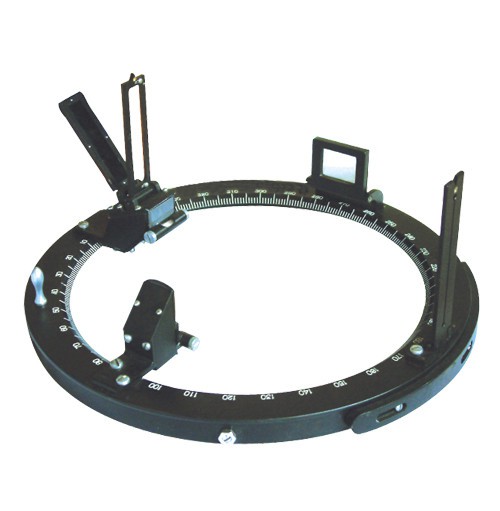
Magnifying glass
Most azimuth circle are smaller than the palm of your hand, and marking 360 degrees on a circle that small can make things tough to read. A magnifying lens will let you get more accurate readings.
Sighting system
If you plan on relying on a compass for real-life navigation, you'll need to do better than a simple floating dial and index line. Sighting systems let you visualize your desired orientation (known as shooting an azimuth) by aligning front and rear sights to identify the exact point in the distance you need to reach to travel in the right direction.
Bezel ring
A bezel ring will let you set your course once for future reference and prevent you from making costly errors later. Military compasses use a notched bezel ring that moves three degrees with each click. For example, to shoot a 30-degree azimuth, you'd rotate your bezel ring ten clicks counter-clockwise. From that point forward, lining up your bezel ring's short line with the magnetic arrow would aim your compass sights directly toward 30 degrees.
Luminous markings
A compass that glows in the dark can be effective at night or in other low-visibility situations. Military compasses use tritium, which does not need to be charged by exposing it to light, to provide luminous markings at key points like magnetic north, the bezel ring, and front sight to aid in night navigation.
Thumb loop
A thumb loop will help you hold your compass steady when shooting an azimuth. Using a compass accurately requires precision, so take all the help you can get.
A back azimuth is a projection of the azimuth from the origin to the opposite side of the azimuth circle. There are 360 degrees in the azimuth circle, so the opposite direction would be 180 degrees (half of 360 degrees) from the azimuth.
A back azimuth is calculated by adding 180° to the azimuth when the azimuth is less than 180°, or by subtracting 180° from the azimuth if it is more than 180°. For example, if an azimuth is 320°, the back azimuth would be 320° - 180° = 140°. If the azimuth is 30°, the back azimuth would be 180° + 30° = 210°.
Backsighting is a method of sighting that uses an azimuth reading taken backwards. Backsighting uses the azimuth sight and turns it around to find the way back to the original starting point.
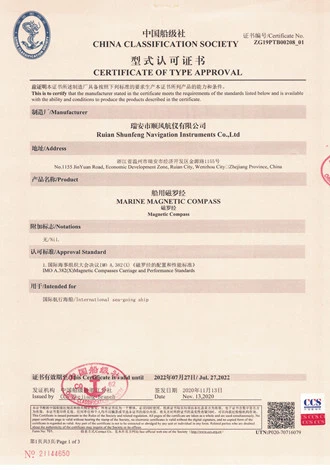
All our products are approved by China Classification Society and China fishing boat inspection bureau and obtain CCS and ZY type approval certificates. Our company has been found to conform to Quality Management System standard ISO 9001:2000 approved by China Classification Society Quality Assurance (CSQA).




Q: What is azimuth in simple terms?
Q: What instrument is azimuth circle?
Q: What is the importance of azimuth circle?
Q: Why is it called azimuth?
Q: What is the difference between an angle and an azimuth?
Q: What is the altitude and azimuth circle?
Q: What are the three types of azimuth?
Q: What is the purpose of altitude and azimuth?
Q: What is azimuth also known as?
Q: What is the opposite of the azimuth?
Q: What is the azimuth circle on a compass?
Q: What is an azimuth circle on a ship?
Q: What is a repeater compass?
Q: What is the purpose of azimuth compass?
Q: What is the function of the azimuth circle in a gyro compass?
Q: What is the azimuth circle a navigational instrument used to measure?
Q: What is an example of an azimuth direction?
Q: How do you read an azimuth chart?
Q: What is the purpose of azimuth compass?
Q: What is a azimuth compass used for?
with over 35 years' experience, we are one of the leading azimuth circle manufacturers and also a professional supplier in China. Welcome to wholesale our quality and steady azimuth circle. Competitive price and excellent service are available.
, azimuth compass , marine azituth , azimuth circle compass , compass bearing(0/10)



