
Quality products
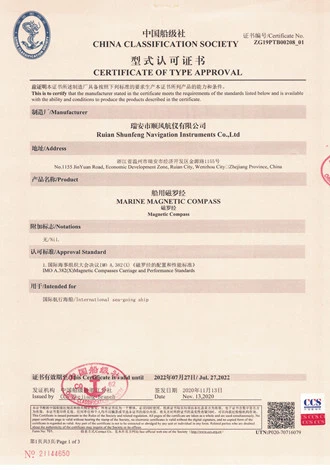
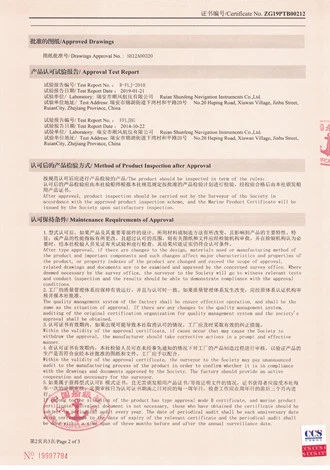
We have the most advanced production equipment, and our products are approved by China Classification Society and China fishing boat inspection bureau and obtain CCS and ZY type approval certificates.
Rich experience
Since its establishment in 1980, we have been widely recognized and highly praised by enterprises and consumers for our excellent quality and thoughtful service.
Reliable service
Our team is committed to providing reliable and consistent service, ensuring that you receive high-quality products and customer support from us every time.
Professional team
The company is in possession of numbers of senior engineers and has abundant technique power, well conditioned equipment and technology comes to perfection.
A magnetic compass is a device that assists the operator of a pleasure craft in determining direction and measuring the boat's heading. This device contains a magnetic element that, when allowed to float freely, will align itself in a north-south direction, pointing towards the earth's magnetic poles. It is a reliable way to determine direction that doesn't require power of any kind or the ability to see land, the sun or the stars. It gives boaters a way to navigate when out of view of the shore or when visibility is reduced.

As society's reach extends to the moon and other planets, you might ask, "would a magnetic compass work on the moon?" Celestial bodies have some principles in common such as gravity, and some major differences as well. Earth's magnetic field is not based in particular on its size or shape, it's a specific effect of the outer core of our planet which is fluid. The molten material which flows slowly as the planet rotates has a high iron content, which generates electricity and from that, a magnetic field. It's called a "self-exciting dynamo effect," where a dynamo is a simple type of electric generator.
● Molten iron is not the only factor in the Earth's magnetic field, the crust, ionosphere, and magnetosphere also can influence it.
● Variation error of the magnetic compass is caused by changes over time in all these factors.
● From the time of the first Chinese magnetic compass to today, there have been significant changes in the magnetic field it interprets.
● As an aviator, mariner, or even a hiker travels, it's important to consider magnetic compass deviation as well, based on local effects on compass readings.
Portability
Magnetic compasses are relatively small and lightweight, making them easy to transport. This makes them ideal for surveying in remote areas or where access is limited.
Accuracy
Magnetic compasses can be used to measure directions with a high degree of accuracy. This is because the magnetic needle in a compass is very sensitive to changes in direction.


Versatility
Magnetic compasses can be used for a variety of surveying tasks, including locating points on a site, traversing an area, and determining the magnetic declination.
Cost-effectiveness
Magnetic compass surveying is a relatively inexpensive method of surveying. This is because compasses are relatively inexpensive to purchase, and they do not require any special equipment or training to use.
A magnetic compass is a very critical piece of marine navigational equipment. It has a magnetized needle which suspends freely. It points North because of the forces caused by the Earth's magnetic field. After knowing North, the other directions are easily found.
A magnetic compass works because the Earth is like a very big magnet and surrounded by a huge magnetic field. The Earth has two magnetic poles near the North and South poles. This magnetic field of the Earth causes a magnetized 'needle' of iron or steel to swing freely into a north-south position.
A magnetic compass works easily by utilizing the Earth's magnetism in order to find directions. After its invention, people become unable to perform navigation over long distances across the sea. A compass points towards the north because all magnets have two poles, a north pole, and a south pole.
The north pole of one magnet is attracted towards the south pole of another magnet. As we know that the Earth is a magnet which can interact with other magnets in this way. Thus, the north end of a compass magnet is drawn to align with the Earth's magnetic field.
Since the Earth's magnetic North pole attracts the "north" ends of other magnets, so it is technically the "South Pole" of our planet's magnetic field.

Prismatic compass
A prismatic compass is a type of magnetic compass which is used to line up with an object to determine its bearing. It has a glass prism or a lens along with a lid. They also consist of a magnifying glass, a light and a ruler to read maps. The image shown below depicts a prismatic compass.
Liquid compass
A liquid compass is a type of magnetic compass which has a magnetized needle and a circular disk card which is present inside a capsule filled with a liquid. The liquid can be anything. It can be lamp oil, ethyl alcohol, white spirits, etc. The image shown below depicts a liquid compass.
Marine compass
A marine compass can be defined as the type of magnetic compass which is used by mariners. It is mounted in a fluid and keeps rotating according to its orientation. It is mainly used on boats so that the direction does not get deflected due to its movement. The image shown below depicts a marine compass.
Solid state compass
A solid state compass can be defined as the type of magnetic compass which is present in electrical devices. Generally, they have two or three magnetic sensors present in them, which can read data as well as the orientation of the device. They are generally present in mobile phones, clocks, etc. The image shown below depicts a solid-state compass.
GPS compass
A GPS compass can be defined as a type of magnetic compass which uses satellite signals to navigate. They can detect accurate locations as well as the position of a person. It is also used to calculate the cardinal directions of the Earth. The image shown below depicts a GPS compass.
Base plate compass
A base plate compass can be defined as a type of magnetic compass which has a liquid filled inside of it. It has a rectangular base which is made up of transparent plastic to read a map. It also consists of a ruler, a light and a magnifying glass to read maps with ease. The image shown below depicts a base plate compass.

On navigational charts, you'll see notations for variation, which change over time in a large-scale manner, and deviation, which is specifically noted for a given area on the chart. Deviation can even be noted by heading, with a different deviation in magnetic compass readings for southerly travel versus westerly, for example. For navigation, both variation and deviation need to be applied to the compass heading to determine the true heading on the chart. An important note: it's easy to confuse the arithmetic when calculating true heading from compass, or the reverse, factoring in whether the variation or deviation is east or west.
● A deviation table for magnetic compass readings provides the deviation for each heading in a quick-reference fashion.
● A deviation card for magnetic compass is the name typically used for references used in aircraft.
● When professionals are performing magnetic compass adjustment, they make reference to a deviation curve of magnetic compass data.
In the early days of land and sea exploration, adventurers recorded their travels and experiences and established descriptions and then charts that provided a track for others to follow. Trade routes were developed using those directions. As basic magnetic compasses came into use, they first appeared in China two thousand years ago but as a more decorative than practical device. On a more widespread and practical basis they became popular around the 11th century, and travel became more reliable and efficient.
The simple magnetic compass played a large role in the expansion of people's knowledge of the world, and in the commerce that followed. Sailing trade routes brought exotic goods and spices, and the Silk Road trade route was enhanced by use of the compass. The Silk Road also impacted bringing the device to many new cultures, and in a sweeping leap to today, it's still making a large difference in travel and trade of all kinds.


The magnetic compass works with the Earth's magnetic field principle and shows the magnetic North and South. The magnetic compass has a magnetised needle, that can freely rotate in a horizontal plane. Such a magnetic needle tends to settle in the magnetic meridian.
We can see that the red portion inside the bar magnet and the needle represents the North pole. And, the grey and white portions represent the bar magnet's South pole and the needle. You can observe that the North pole in the magnetic needle is always deflected towards the South pole of the bar magnet and vice-versa.
Magnetic compass should be ideally placed in a place far away from magnetic material or material that shows magnetic properties. This is to make sure that only the earth's magnetic field affects the compass. This has been a major concern in modern ship manufacturing companies as ships these days are mainly built using steel. Steel has permanent, sub permanent & induced magnetism which can disturb the earth's magnetic lines of forces, thus causing an error in the compass. These errors are not fixed, thus if not adjusted/corrected, the compass headings and bearings cannot be relied upon.
Ships are made of steel. Steel is a ferromagnetic material. They are magnetized during the construction of a ship. Magnetic properties induced on steel can be permanent or temporary, and mostly they are permanent due to energy imparted during cutting and welding. Magnetism can also be induced by earth's magnetic lines of forces and also when placed near a permanent magnet.
Effects of permanent magnets onboard the ship can be combined into one single force called permanent magnetic force. Permanent magnetism exist through the life of a ship. The force doesn't change with heading or at poles. Its force does change very slowly over time. This change is also known as sub-permanent magnetism and corrections to this will be carried out together with permanent magnetism. Sub-permanent magnetism is the process of changing the force as a result of cruising, vibration, or ageing.This magnetism, at any instant, is part of the ship's permanent magnetism, and consequently must be corrected by permanent magnet correctors. Induced magnetism on ship changes depending on ships heading, the strength of earth lines of forces, magnetic latitude etc. This magnetism isn't constant as it depends on ferromagnetic properties.


The principle of magnetic compass has not been changed for a long time and it's still being followed. It essentially consists of a magnetized needle pivoted over a horizontal plane.
Magnetic compass is one of the major maritime navigational equipment and its usage is critical. Simply put, a magnetised needle, suspended freely, points north because of the forces caused by the earth's magnetic field. Once north is known, the other directions are easily found. A correctly adjusted compass of a ship is always sailor's best companion. The main advantage of a magnetic needle is that it doesn't need any external power. As long as earth's magnetism exists, a properly adjusted compass will show you correct directions. It works well in most of the navigable waters of the world, except areas closer to magnetic poles. Readings from compass can be easily corrected, variation & deviation is readily available onboard at all times.
The present day magnetic compass has been developed from understanding the laws of magnetism which govern the behavior of the compass, greater precision in the construction of compass and better means to control damping of the compass needle.
The angle between the true and magnetic meridian is called variation. If the magnetic needle is drawn to the right of the true meridian is termed as easterly and if it's to the left of the true meridian, its termed westerly.Variation differs from place to place but does not change with the direction of the ship's head (course of the ship)
Magnetic compass is used to steer the ship on a fixed course. The compass readings needs to be accurate when at sea, because an error of one or two degrees in long sea passages can make a difference of nautical miles in reaching the destination and might consume more time than expected. The compass is also used for taking bearing of terrestrial and celestial objects for navigation. The compass reading at sea must be precise and accurate as much as possible.
A ship made of steel contain magnetic properties. It therefore has an inherent effect on magnetic compass system. Compass needle on board does not lie on the magnetic meridian but is deflected on one side or the other because of the ship's magnetism. Although corrective magnets are inserted in the housing (also called binnacle) of the compass to counteract this, the system is not perfect because the ship also loads steel cargo which makes the error variable. This error is called 'deviation'. Compass error is the combination of variation and deviation. These are applied to compass reader by the sailor to get the corrected compass read.

All our products are approved by China Classification Society and China fishing boat inspection bureau and obtain CCS and ZY type approval certificates. Our company has been found to conform to Quality Management System standard ISO 9001:2000 approved by China Classification Society Quality Assurance (CSQA).




Q: What is a magnetic compass in simple terms?
Q: What is the uses of magnetic compass?
Q: What is magnetic compass on ship?
Q: Why was the magnetic compass important?
Q: What is a magnetic compass and how does it work?
Q: What is a compass used for short answer?
Q: How did sailors use the magnetic compass?
Q: Who invented the magnetic compass?
Q: What is a magnetic compass and how does it work?
Q: What are the advantages of gyro compasses vs magnetic compasses?
Q: What are the two errors of magnetic compass?
Q: What is the principle of magnetic compass work?
Q: What is the principle of magnetic compass and gyro compass?
Q: Why is a magnetic compass used to determine direction?
Q: What are the 5 points on a magnetic compass?
Q: What is the theory of magnetic compass adjustment?
Q: Why does a magnetic compass always point towards north?
Q: Why do magnetic compasses become useless in the geographic poles?
Q: What is a heeling error in a magnetic compass?
Q: Why does a magnetic compass have errors?
with over 35 years' experience, we are one of the leading magnetic compass manufacturers and also a professional supplier in China. Welcome to wholesale our quality and steady magnetic compass. Competitive price and excellent service are available.
, compass , binnacle , marine compass , marine magnetic compass , nautical compass(0/10)



